
CSE: HHE | FSE: 0NB | OTC(PINK): BTKRF

CSE: HHE | FSE: 0NB | OTC(PINK): BTKRF
CSE: HHE | OTC Pink: BTKRF | FSE: 0NB

Our Projects — Québec
where surface readings exceeded 7,000 ppm H₂ at only 50 metres depth. Under a formal strategic partnership, QIMC is applying its full Reactivated Rift and Graben Geostructure (R2G2) exploration model to Matane, including INRS scientific oversight — the same team and methodology now delivering confirmed multi-zone H₂ discoveries in Nova Scotia.
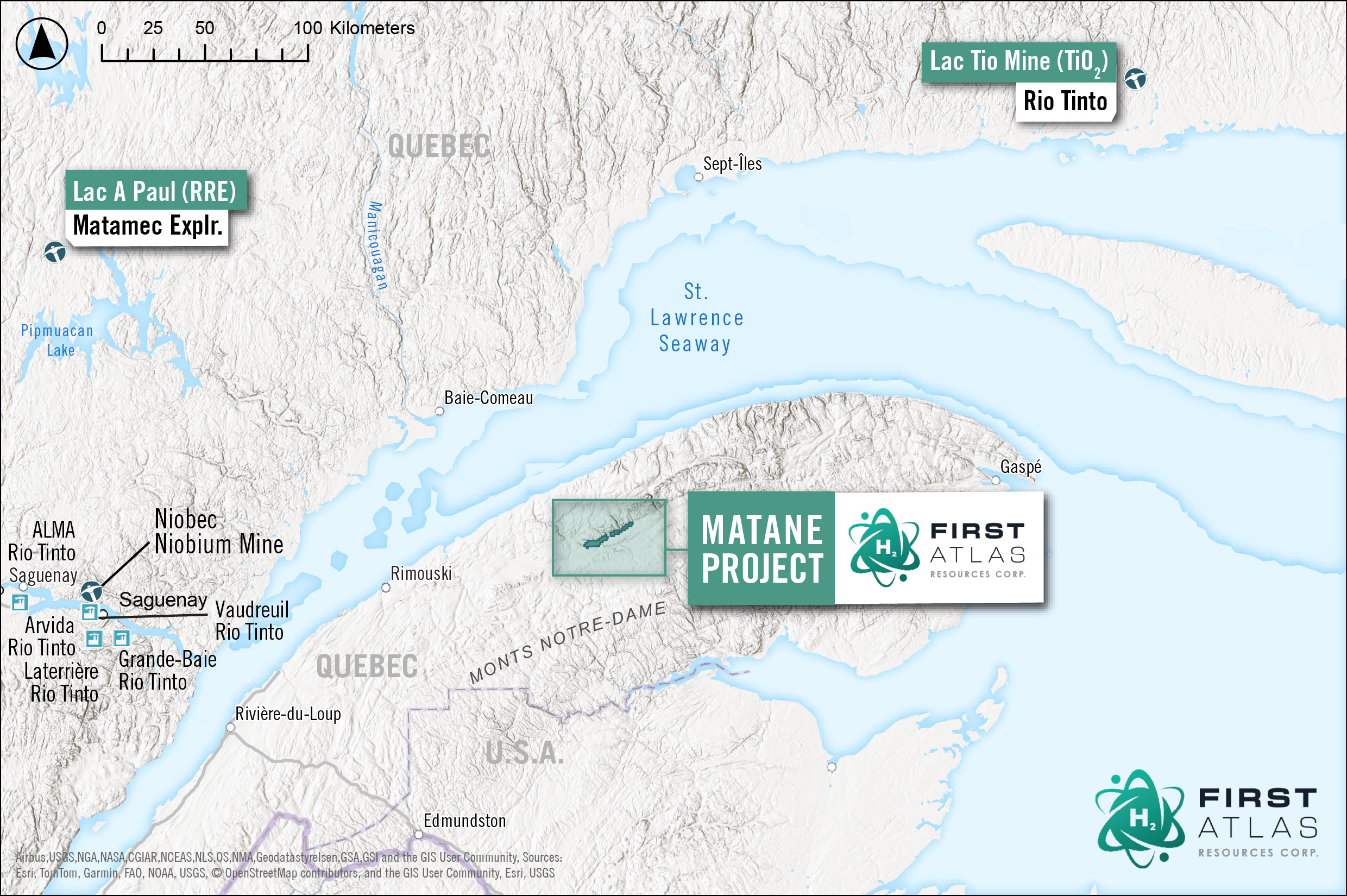
*Click image to enlarge
Our Projects — Québec
Appalachian Region, Québec
26km along Schickshock- South Fault Zone
80 claims
Direct road access via Route 195
Why Matane Mirrors The Proven R2G2 Template
| Geological Feature | St Bruno De Guigues (QIMC Proven) | Matane Project (HHE / QIMC) |
|---|---|---|
|
Ultramafic Source Rocks
|
Serpentinized peridotites; olivine-rich
ophiolitic complex |
Ordovician peridotites (Ruisseau-Isabelle mélange);
magnetite-rich basalts (Schickshock Group) |
|
H₂ Generation Mechanism |
Serpentinization & radiolytic water-rock
reactions at depth |
Same — deep groundwater circulation through
peridotites and tectonized zones drives serpentinization |
|
Structural Control
|
Multi-km fault system along Lake Témiscamingue
outlet; R2G2 rift graben architecture |
26 km Schickshock-South fault zone corridor — crustalscale
structure highly conducive to H₂ migration |
|
Sedimentary Host |
Carboniferous basin sediments acting
as structural traps |
Arkosic sedimentary formations in tectonic transition
zone (Cambro-Ordovician / Siluro-Devonian) |
|
Proven Surface Signal |
>7,000 ppm H₂ at only 50m depth — one of
highest shallow Proven Surface Signal readings in Canada |
Soil sampling + geophysical surveys in progress;
targeting analogous fault-bound zones |
R2G2 Methodology Deployment
Soil gas sampling program using QIMC's proprietary field protocols — same multi-gas detection approach (H₂, CH₄, CO₂, H₂S) deployed in Nova Scotia and St-Bruno-de-Guigues. High-precision magnetic and gravity surveys to map ultramafic rock formations rich in olivine and magnetite — direct analogs to the rock suites driving generation at St-Bruno-de-Guigues.
Hydrogeological and geochemical studies evaluating the role of deepseated groundwater circulation in hydrogen formation — serpentinization and water-rock reaction modeling led by INRS.
Integration of all datasets to define priority drill targets along the Schickshock-South fault corridor, replicating the pre-drill targeting workflow that produced the West-Advocate discovery.
Dr. Mathieu Piché (OGC) serves as Qualified Person for Québec exploration programs.
R2G2 Methodology Deployment
The Schickshock-South fault zone spans 26 km — a crustal-scale structure that, per the R2G2 model, acts as the primary conduit for upward hydrogen migration from deep peridotitic source rocks.
Ordovician peridotites of the Ruisseau-Isabelle mélange are the same rock type responsible for serpentinization-driven H₂ generation documented globally and confirmed at QIMC's St-Bruno project.
Structural complexity: Tectonic transition zone (Cambro-Ordovician / Siluro-Devonian) introduces structural complexity — multiple orogenic overprints create the fracture permeability and reactivated fault geometries central to the R2G2 model.
Arkosic sedimentary cover above the basement provides the same trap architecture identified at QIMC's Quebec discoveries.
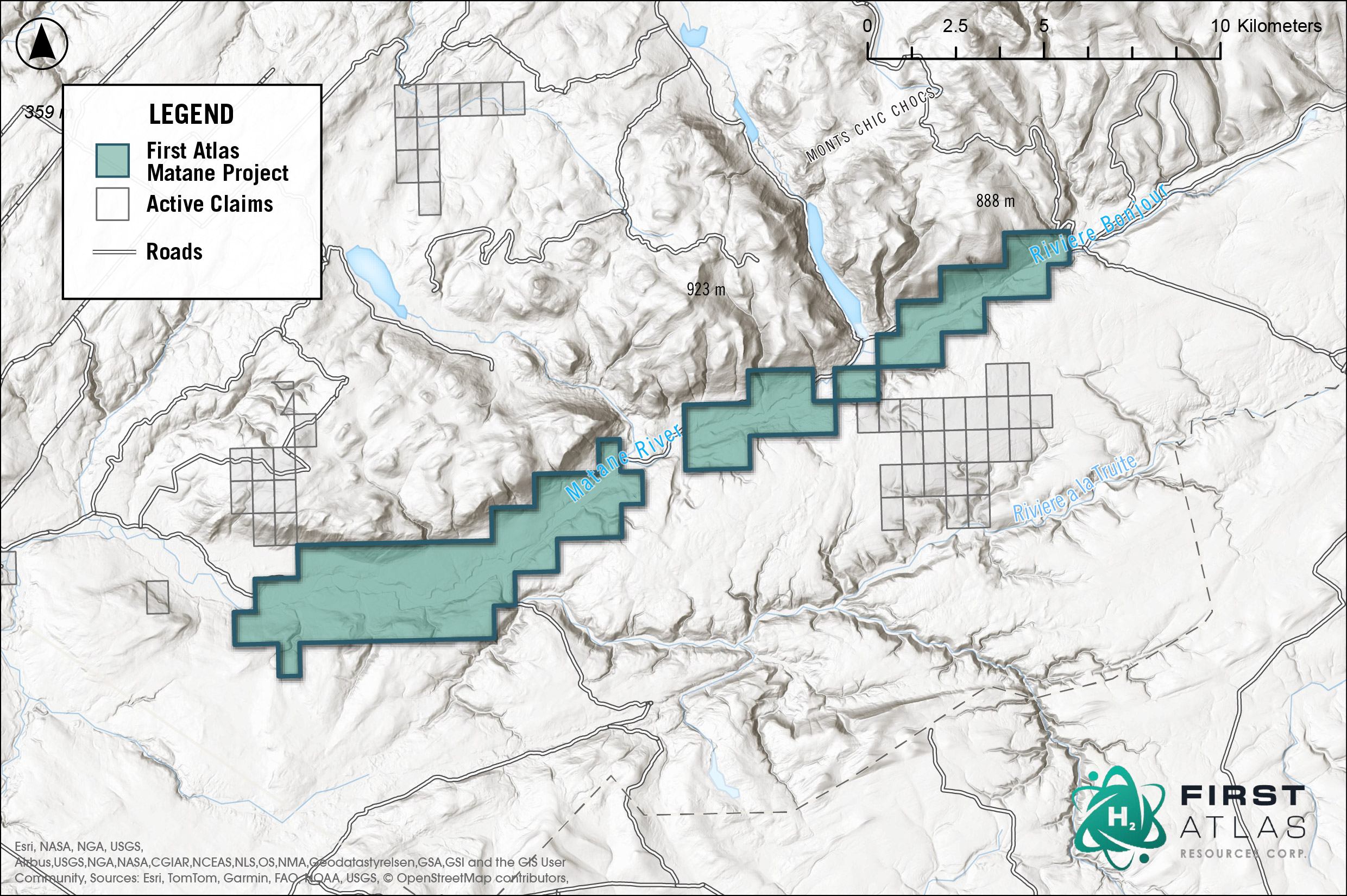
*Click image to enlarge
R2G2 Methodology Deployment
Earliest-stage, highest-optionality position: Matane has not yet been drilltested — soil gas + geophysics currently defining priority targets
QIMC's proven Quebec track record (>7,000 ppm H₂ at 50m at St-Bruno) directly validates the Appalachian geological model underpinning Matane
100% HHE ownership with QIMC as operator provides institutional-quality technical governance at junior exploration cost
Québec's supportive clean energy policy framework and proximity to industrial H₂ demand centres enhances long-term commercialization pathway
3 structurally separate H₂ zones in a single borehole at 142m, 313m, and 354m — confirming district-scale system continuity.
72 metres at 354m; system remains open below 711m — scale not yet bounded.
INRS-verified true in-situ concentration modelled at potentially 21%+ by volume at depth.
Confirms inorganic, structurally hosted origin, not thermogenic hydrocarbons.
FORWARD-LOOKING STATEMENT DISCLAIMER:
This document contains forward-looking statements based on current expectations, field observations, and preliminary data. No resource estimate or commercial viability has been established. Past exploration success does not guarantee future results. This is not an offering document. Investors should conduct their own due diligence. First Atlas Resources Corp. (HHE): richard@qmetalscorp.com | CEO: Richard Penn, (778) 384-8923
Get notified about the latest company news and updates by signing up below.